
If you’ve ever stood in the aisle of a hardware store holding a bundle of sisal rope and thought, “I really hope this is enough,” you’re not alone. Making or repairing a cat scratching post sounds simple at first. Wrap rope around a post, glue as you go, and let your cat go to town. But anyone who has actually done it knows that the details matter. One of the biggest details, and one that catches people off guard, is the shape of the post itself.
Here at BellenPaws, we’ve built, repaired, and rebuilt more cat posts and cat trees than we can count. Many of them were made for senior cats who didn’t just scratch for fun, but relied on those posts to stretch stiff joints, keep their balance, and maintain a sense of normalcy as their bodies changed with age. Over time, we learned the hard way that post shape can dramatically change how much rope you need and how well the finished post works for your cat.
This article is meant to walk through that idea in plain language. No engineering degrees required. Just real-world experience, practical reasoning, and a little empathy for anyone who has ever underestimated rope length and had to stop halfway through a project.
Why Scratching Posts Matter More for Senior Cats
 Before diving into measurements and shapes, it’s worth pausing to talk about why this matters so much, especially for older cats.
Senior cats often scratch differently than younger ones. They may scratch lower to the ground because standing tall hurts their hips or spine. They may grip the rope longer to stretch sore muscles. Some use the post almost like a support column, leaning into it to stabilize themselves. For cats with arthritis, vision loss, or balance issues, a sturdy, well-wrapped post isn’t a luxury. It’s part of their daily comfort and mobility.
When a post is poorly wrapped, uneven, or runs out of rope partway up, senior cats notice. Loose rope can snag claws. Gaps can cause slipping. A post that’s too smooth because the rope coverage is thin just doesn’t give them the traction they need. That’s why getting the rope length right is about more than saving money. It’s about building something safe and dependable.
The Basic Idea Behind Rope Length
At its simplest, wrapping a post with rope is about covering distance. You’re wrapping rope around the outside of a shape, layer by layer, from bottom to top. The total rope length depends on three main things:
- The height of the post
- The distance around the post (its perimeter)
- How tightly and closely the rope is wrapped
Most people focus on height first, which makes sense. A taller post obviously needs more rope. But the shape of the post determines the distance around it, and that distance is repeated over and over again for every wrap. Small differences add up fast.
Round Posts: The Most Predictable Shape
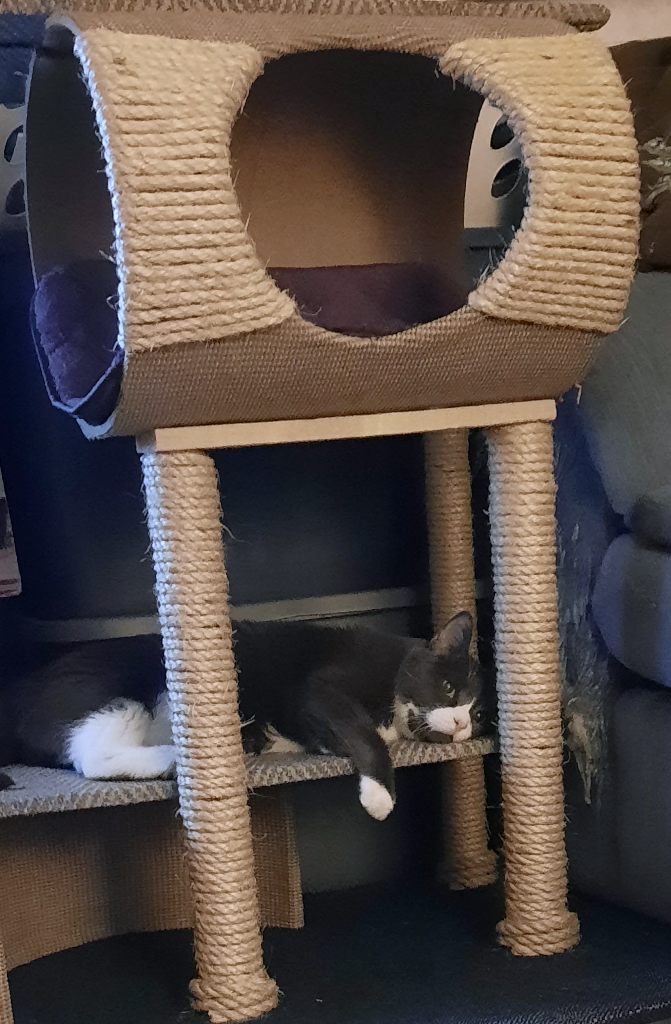
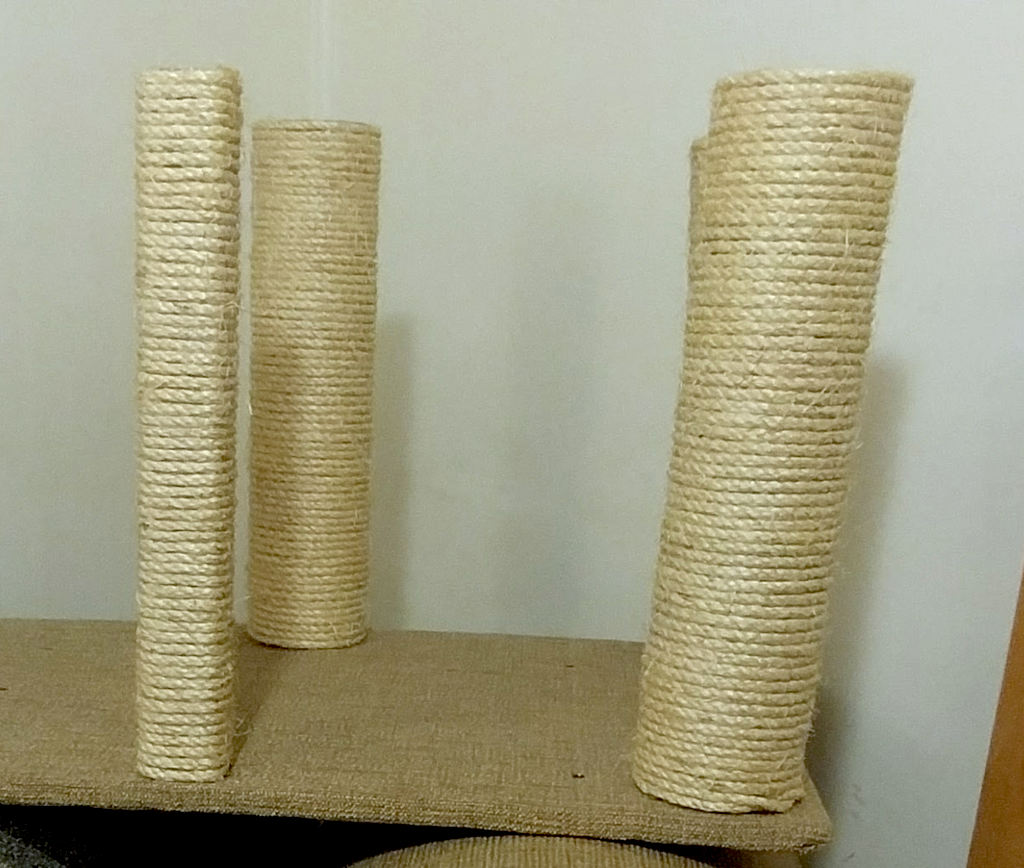 Round posts are the most common and, thankfully, the easiest to calculate. When the post is a cylinder, every wrap goes around the same smooth curve. The distance around it never changes from top to bottom.
If you’ve ever wrapped a mailing tube, a broom handle, or a piece of PVC pipe, you already understand this intuitively. Each turn of rope uses the same amount of length. Multiply that by the number of turns, and you get a pretty reliable estimate.
This consistency is why round posts are often recommended for first-time DIY builders. They’re forgiving. If your wraps aren’t perfectly tight, you’ll still end up close to your estimate. For senior cats, round posts also offer a uniform surface that’s easy to grip from any angle.
Square Posts: Where Things Start Getting Tricky
Square posts are extremely common in DIY cat trees because they’re easy to build from standard lumber. At first glance, they seem almost the same as round posts except four flat sides instead of a curve. But those corners change everything.
When you wrap rope around a square post, the rope doesn’t follow a smooth circle. It bends sharply around each corner. That extra bending uses more rope per wrap than a round post of similar width. Even though the post might look about the same size, each loop of rope is slightly longer.
Those corners also introduce tiny gaps if the rope isn’t pulled tight. Over many wraps, those gaps add up, increasing the total rope needed more than you might expect. This is one of the most common reasons people run short on rope when working with square posts.
From a cat’s perspective, square posts can be wonderful. Many cats, especially seniors, like the defined edges. They can hook their claws into the corners and get a more secure grip. But from a builder’s perspective, square posts demand a little more planning.
Rectangular Posts: Same Problem, Just Stretched
Rectangular posts take everything tricky about square posts and stretch it out. Two sides are longer, two are shorter, and that means the distance around the post is uneven in feel, even if the math still works out cleanly.
Each wrap still travels around all four sides, but the rope may settle differently on the longer faces. This can lead to subtle spacing changes, especially if the rope is slightly stiff. The longer sides may show more visible gaps if you’re not careful.
For senior cats, rectangular posts can be helpful when positioned correctly. A wider face can give extra support for leaning or stretching. But once again, builders often underestimate rope needs because the post doesn’t look that much bigger than a square one.
Irregular or Natural Posts: Expect the Unexpected
Some people love using natural wood branches or irregular posts for cat trees. They can look beautiful and feel more “organic.” But from a rope calculation standpoint, these are the hardest to predict.
Irregular posts change diameter as you move up or down. Knots, bumps, and slight curves mean that every wrap is a little different. Some wraps use more rope, some less, but overall the total usually ends up being more than a clean, uniform post of the same height.
For senior cats, natural posts can be hit or miss. Some love the varied texture. Others struggle with balance if the surface isn’t consistent. If you do choose this route, it’s wise to buy extra rope and accept that precision isn’t realistic here.
Rope Thickness Changes Everything
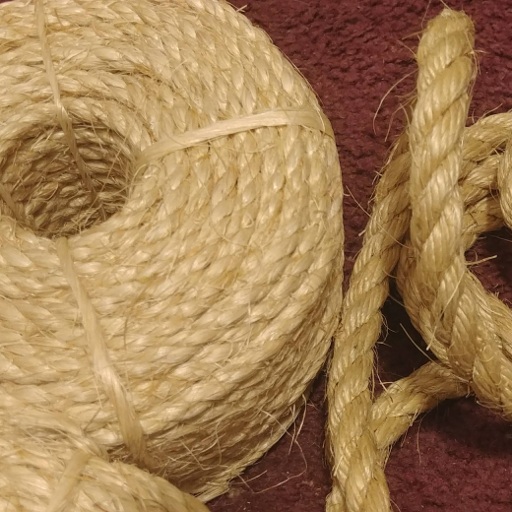 Post shape doesn’t work alone. Rope thickness interacts with shape in important ways.
Thicker rope covers more vertical space with each wrap, which means fewer total wraps. That sounds like it would reduce rope length, and sometimes it does but not always by much. Thicker rope also bends less easily around corners, which increases rope usage on square or rectangular posts.
Thinner rope bends easily but requires more wraps to cover the same height. On a round post, that’s usually predictable. On a square post, those extra wraps mean extra trips around the corners, and that adds up.
For senior cats, rope thickness matters for comfort too. Very thin rope can feel rough on sensitive paws. Very thick rope can be harder to grip for cats with arthritis. We’ve found that a middle ground works best, especially when paired with a shape that provides good traction.
Tension and Tightness: The Human Factor
No two people wrap rope exactly the same way. Some pull tight with every wrap. Others keep things a bit looser. That difference alone can change your final rope usage by several feet.
On round posts, loose wrapping usually just means the rope compresses later. On square posts, loose wrapping almost always increases rope consumption because the rope spreads slightly at the corners.
If you’re building for a senior cat, tighter wrapping is usually better. It creates a firmer surface that won’t shift under weight. Just remember that tighter wrapping means you should plan for a bit more rope than the bare minimum.
Learning the Hard Way (So You Don’t Have To)
We’ve been there. Halfway up a post, glue drying, cat watching with judgment in their eyes and suddenly the rope runs out. That’s usually when the shape realization hits. “Oh. Those corners are eating my rope.”
That experience is one of the reasons we eventually created tools like our rope length calculator. Not because math is fun, but because frustration isn’t. When you’re caring for senior pets, your energy is already spread thin. DIY projects should help, not add stress.
Building With Seniors in Mind
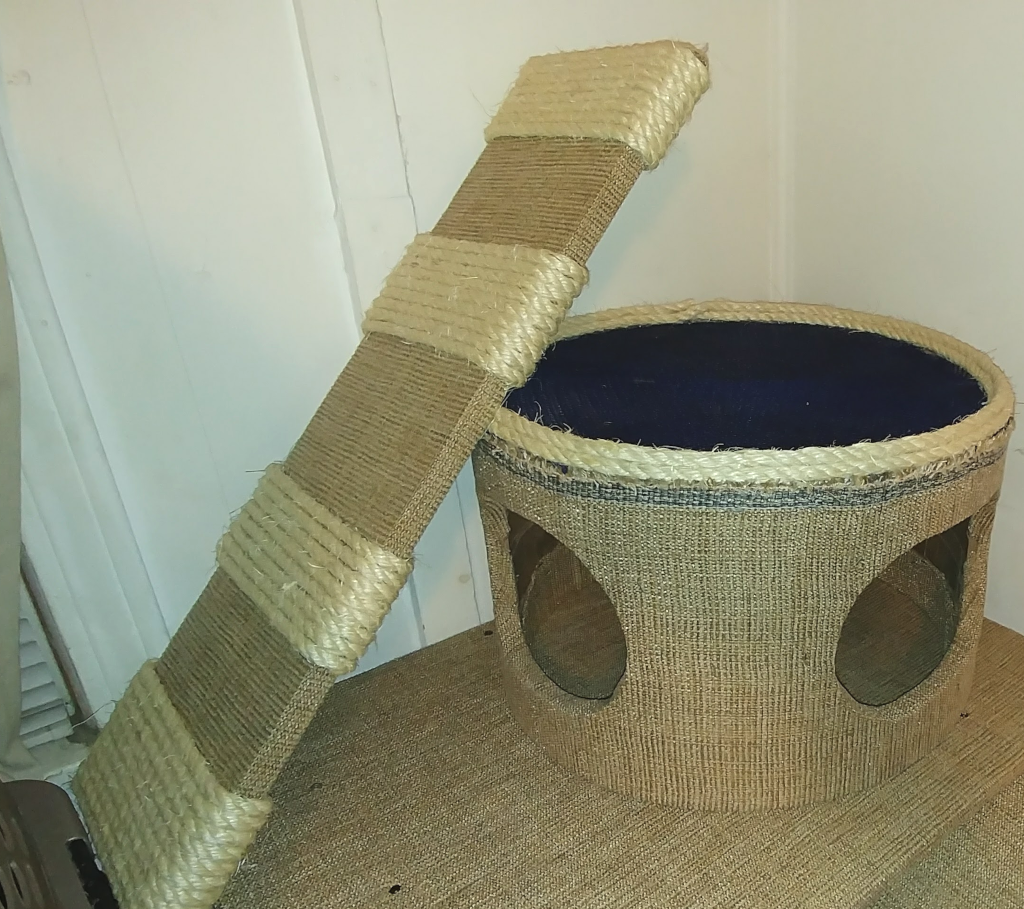 When choosing a post shape, rope, and height, it helps to think about how your cat actually uses the post.
- Does your cat stretch tall, or keep things low?
- Do they lean heavily into the post?
- Do they favor one side due to stiffness or vision issues?
Round posts offer consistency and are easy to wrap. Square and rectangular posts offer grip and support but demand more rope and patience. Irregular posts look nice but are unpredictable.
There’s no single “right” choice. The best post is the one your cat feels confident using and the one you can build without burning out.
A Final Thought
DIY projects like cat scratching posts aren’t really about wood and rope. They’re about creating small, meaningful comforts for animals who’ve shared their lives with us for years. Senior pets don’t need perfection. They need stability, safety, and familiar routines.
Understanding how post shape affects rope length calculations won’t just save you a return trip to the store. It helps you plan better, build smarter, and end up with something that truly serves your cat, especially in their later years.
If this article helps even one person avoid running out of rope halfway through a build, or helps one senior cat feel more secure during a daily stretch, then it’s done its job. And if you’ve ever found yourself short on rope with glue on your hands, just know you’re in good company here.