
If you have ever sat there staring at a glucose curve, feeling your chest tighten as you try to make sense of all those numbers, you are not alone. I remember the first time we charted one for Bentley. I had the paper in front of me, rows of times and readings, and all I could think was, “What am I even looking at?” It felt like I was supposed to understand something important, something that mattered deeply for his health, but no one had handed me a simple way to read it.
That feeling of overwhelm is something many of us go through when caring for a diabetic pet. The good news is this: glucose curves are not meant to confuse you. They are simply a story. Once you learn how to read that story in a calm, step by step way, everything starts to click into place.
Let’s slow it down together and walk through it in a way that actually makes sense.
Understanding What a Curve Is Really Showing You
 At its core, a glucose curve is just a snapshot of how your pet’s blood sugar changes over time after insulin is given. That is it. There is no hidden complexity beyond that basic idea. Instead of thinking of it as a medical chart, try to picture it as a daily rhythm. You have a starting point, a rise or fall, a lowest point, and then a gradual return. Your pet’s body is responding to food, insulin, activity, and stress throughout that cycle.
When we were working with Zippy during his journey toward remission, I stopped trying to memorize numbers and instead asked simple questions. Where did he start? How low did he go? How long did the insulin seem to work? Those three questions told me far more than any individual reading ever could.
A curve usually begins at what many call the pre-shot number. This is the glucose reading right before insulin is given. From there, the insulin begins to take effect, and the glucose levels start to drop. Eventually, they reach their lowest point, often referred to as the nadir. After that, the numbers rise again as the insulin wears off.
When you look at a curve this way, it stops being a confusing grid and starts becoming a story with a beginning, middle, and end.
Letting Go of the Need to “Get It Perfect”
One of the biggest sources of overwhelm comes from feeling like every number needs to be interpreted perfectly. That pressure can make even the simplest curve feel intimidating. Here is something that helped me tremendously. A single curve is not a final answer. It is just one piece of information. Your pet’s glucose levels can vary from day to day depending on appetite, stress, illness, or even something as simple as a change in routine.
Bentley had curves that looked beautifully smooth one week and then completely different the next. If I had judged his progress based on one chart alone, I would have been constantly second guessing everything.
Instead, think of curves as patterns over time. You are not trying to decode one perfect graph. You are looking for trends that repeat. That shift in mindset takes a lot of pressure off.
Finding the Most Important Points Without Getting Lost
 When you first look at a glucose curve, it is easy to get distracted by every number. Your eyes jump from one reading to the next, trying to make sense of it all at once. That is where overwhelm creeps in. A much calmer approach is to focus on just a few key moments.
Start with the first reading before insulin. This gives you a baseline. Then look for the lowest number on the chart. That is your nadir, and it tells you how strongly the insulin is working. Finally, notice how long it takes for the numbers to rise again. That is really the heart of the curve.
When we were managing Zippy’s diabetes, I would circle those points on our printed charts. It helped me visually simplify everything. Instead of ten or twelve readings, I was focusing on three or four meaningful markers.
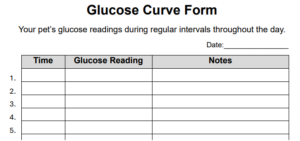
If you are using something like our online diabetes tracker or even printable glucose curve forms, this becomes even easier. Having a clean layout where you can highlight or annotate those key points can turn confusion into clarity pretty quickly.
Learning to See Patterns Instead of Isolated Numbers
This is where things start to feel less overwhelming and more empowering. A single high reading can feel scary. A single low reading can feel even scarier. But neither of those numbers tells the full story on its own. What matters is how those numbers connect.
Ask yourself simple questions as you review a curve. Are the numbers dropping steadily after insulin? Is there a sharp drop that might be too fast? Does the glucose stay low for a while, or does it bounce back quickly? Over time, these patterns become familiar.
With Bentley, I began to recognize his rhythm. I knew roughly when his insulin would peak and when it would start to wear off. That didn’t mean every day was identical, but it gave me a sense of predictability that made everything feel less chaotic.
You will develop that same intuition with your pet. It does not happen overnight, but it does happen.
Making Peace With the Emotional Side of Monitoring
We do not talk about this part enough. Reading glucose curves is not just a technical task. It is an emotional one. Every number can feel like a reflection of how well you are doing as a caregiver. If the numbers are higher than expected, it is easy to feel like you made a mistake. If they drop lower than you are comfortable with, fear can take over.
I have been there more times than I can count. What helped me was reminding myself that these numbers are not judgments. They are information. They are tools that help you make decisions, not measures of your worth or your effort.
Your pet does not see a spreadsheet. They see you showing up, testing, feeding, giving insulin, and caring deeply. That matters more than any single curve ever will.
Using Tools to Simplify the Process
 Sometimes the overwhelm comes not from the data itself, but from how it is presented. Messy notes, scattered readings, or trying to keep everything in your head can make things unnecessarily stressful. This is where simple tools can make a big difference.
On our site, we have always believed in making this process more approachable. Whether it is an online diabetes tracker that organizes your data or printable glucose curve forms you can bring to your vet, the goal is the same. Make the information easier to see, easier to understand, and easier to share.
When everything is laid out clearly, patterns become more obvious. You are no longer trying to piece things together. You are simply observing what is already there.
Giving Yourself Time to Learn
No one becomes comfortable with glucose curves overnight. It is a skill, and like any skill, it takes repetition. In the beginning, it might feel like you are guessing. That is okay. Over time, those guesses turn into informed observations, and those observations turn into confidence.
I remember looking back at our early notes with Zippy and realizing how much we had learned without even noticing it happening. What once felt overwhelming had become second nature.
You will get there too.
Trusting the Bigger Picture
 At the end of the day, glucose curves are just one part of caring for a diabetic pet. They are important, but they are not the whole story. Your pet’s behavior, appetite, energy levels, and overall comfort matter just as much. Sometimes more.
If your pet is eating well, engaging with you, and showing signs of feeling good, that is meaningful. The numbers should support that picture, not replace it. When you combine what you see on the curve with what you see in your pet, you get a much fuller understanding of their health.
A Gentle Reminder as You Move Forward
 If you are feeling overwhelmed right now, take a breath. You are doing something incredibly important for your pet. The fact that you are even trying to understand glucose curves means you care deeply. Start simple. Look for the story, not perfection. Focus on patterns, not individual numbers. Use tools that make things clearer. And most importantly, give yourself grace as you learn.
We have walked this path with pets like Zippy and Bentley, and I can tell you from experience that it does get easier. What feels confusing today can become familiar tomorrow. You are not alone in this. And you are more capable than you think.