
Taurine is one of those nutrients that receives little attention until someone starts examining the ingredients in their cat’s food. It often appears near the bottom of an ingredient list, alongside vitamins and minerals, yet it supports several functions that cats depend on throughout their lives. Without an adequate supply, a cat can develop serious problems involving the heart, eyesight, and other essential bodily processes.
Fortunately, taurine deficiency is now relatively uncommon among cats eating nutritionally complete commercial diets. Veterinary research conducted during the 1980s helped establish the connection between taurine deficiency and certain forms of feline heart and eye disease, leading manufacturers to improve their nutritional formulations. Understanding where taurine comes from, how food preparation affects it, and which feeding practices may create deficiencies is particularly useful for people caring for senior cats or animals with specialized dietary needs.
What Is Taurine, and Why Do Cats Need It?
Taurine is an amino acid that participates in several important biological functions. Although amino acids are commonly described as the building blocks of proteins, taurine differs from most because it is not incorporated into proteins during normal protein synthesis. Instead, it exists in various tissues throughout the body, particularly in areas such as the heart, retina, and nervous system, where it performs specialized functions.
What makes taurine especially important for cats is their limited ability to manufacture it themselves. Many mammals can produce sufficient taurine from other amino acids, primarily methionine and cysteine. Cats possess some of the same metabolic pathways, but their production capacity is too limited to satisfy their normal requirements. Consequently, taurine is classified as an essential dietary nutrient for cats, meaning they must obtain enough of it through food.
This requirement reflects the specialized nutritional needs of obligate carnivores. Cats evolved consuming prey that supplied nutrients naturally present in animal tissues, including taurine, preformed vitamin A, and certain fatty acids. Their metabolism remains dependent on obtaining these nutrients in suitable forms and quantities, even though domestic cats no longer need to hunt for their meals.
The Merck Veterinary Manual’s discussion of feline nutritional requirements identifies taurine as essential and describes the consequences of deficiency. Unlike nutrients that can be stored in substantial reserves, taurine requires regular dietary replenishment. A cat consuming inadequate amounts may appear healthy for months while tissue concentrations gradually decline, which helps explain why deficiency-related problems can develop without obvious early symptoms.
How Taurine Supports Your Cat’s Health
Heart Function and Cardiovascular Health
 One of taurine’s best-documented roles involves maintaining healthy heart muscle function. Severe deficiency can contribute to dilated cardiomyopathy, commonly abbreviated as DCM. This condition causes the heart’s chambers to enlarge while the muscular walls become thinner and contract less effectively, reducing the heart’s ability to circulate blood.
The connection between taurine deficiency and feline DCM became established through veterinary research in the 1980s. A landmark 1987 study published in the journal Science identified an association between low blood taurine concentrations and impaired heart function in affected cats. Researchers also documented improvements in heart function following taurine supplementation, helping establish taurine deficiency as a treatable cause of some cases of feline DCM.
These findings significantly influenced commercial cat food formulation. Manufacturers increased taurine concentrations to meet cats’ nutritional requirements, and deficiency-related DCM became much less common. The improvement represented an important advance in feline nutrition because it addressed a preventable cause of potentially life-threatening heart disease.
Taurine deficiency remains relevant when cats consume inadequately formulated homemade diets or foods intended only for occasional feeding. The Cummings School of Veterinary Medicine at Tufts University explains that unbalanced diets can still contribute to taurine-related DCM. Some affected cats experience substantial improvement after their deficiency is corrected, although recovery depends on the extent of existing heart damage and any complications.
Not every cat diagnosed with heart disease has a taurine deficiency. Hypertrophic cardiomyopathy, or HCM, is the most common feline heart muscle disease and involves abnormal thickening of the heart walls rather than the enlargement and weakening characteristic of DCM. Taurine supplementation is not an established treatment for HCM in cats that already have adequate taurine levels.
Vision and Retinal Health
Taurine also helps maintain the retina, the light-sensitive tissue at the back of the eye that converts incoming light into signals the brain can interpret. When taurine concentrations remain inadequate, retinal cells can gradually deteriorate. This condition is known as feline central retinal degeneration and can eventually cause serious visual impairment or blindness.
The process generally develops over an extended period, making early signs difficult to recognize. A cat may hesitate before jumping, misjudge distances, or appear uncertain in unfamiliar surroundings. However, cats can compensate remarkably well for gradual vision loss by relying on memory, hearing, and their sense of smell, so changes may remain unnoticed until the damage is advanced.
Prolonged taurine deficiency can cause permanent retinal damage. Correcting the deficiency may prevent additional deterioration, but established structural damage to retinal tissue may not reverse. The Merck Veterinary Manual’s information on retinal disorders in cats identifies nutritional taurine deficiency as a recognized cause of retinal degeneration.
Vision changes in older cats also have several other possible explanations, including hypertension, which can damage the eyes and cause sudden blindness. An abrupt change in vision requires prompt veterinary assessment rather than assuming that taurine deficiency is responsible. The speed at which symptoms develop, along with an examination of the eyes and the cat’s medical history, helps distinguish among possible causes.
Digestion, Growth, and Reproduction
 Taurine contributes to normal fat digestion through its role in bile salt formation. Bile is produced by the liver and helps the digestive system break down and absorb dietary fats. Cats depend on taurine to conjugate bile acids, a process that helps these compounds function properly within the digestive system.
Adequate taurine intake is also necessary during pregnancy and kitten development. Controlled nutritional studies have demonstrated that severe taurine deficiency in breeding cats can interfere with reproduction, reduce kitten survival, and impair normal growth and development. These findings support the need for appropriately formulated diets during pregnancy, nursing, and early life.
The nutritional demands of growing kittens differ from those of adult cats, so a food intended for adult maintenance should not automatically be considered suitable for reproduction or growth. Diets formulated for kittens or all life stages are designed to address those additional requirements. Taurine is only one component of the broader nutritional balance needed during these periods.
Where Does Your Cat Get Taurine?
Animal-Based Foods
Taurine occurs naturally in animal tissues, making meat and seafood important dietary sources. Muscle tissue contains varying amounts, with concentrations influenced by the animal species and the particular tissue being consumed. Certain organs and marine animals contain relatively high amounts, although the actual concentration can vary substantially between ingredients.
Poultry, beef, fish, and shellfish are among the animal-derived foods that can contribute taurine to a cat’s diet. Dark poultry meat and some actively working muscle tissues may contain higher concentrations than other cuts. Plant ingredients generally contain little or no taurine, although the nutritional adequacy of a finished food depends on its complete formulation rather than the presence of animal ingredients alone.
A meal containing plenty of meat is not necessarily nutritionally complete. Plain chicken, beef, or fish may provide protein and taurine while supplying inadequate calcium or inappropriate proportions of other essential nutrients. Feeding meat without a properly balanced formulation can therefore create nutritional problems even when the ingredients themselves appear wholesome.
The amount of taurine naturally present in food also cannot be estimated reliably from its appearance or protein content. Two ingredients with similar amounts of protein may contain substantially different taurine concentrations. For a cat’s regular diet, the nutritional quality of the finished meal matters more than selecting individual ingredients because they are believed to contain particularly high amounts of taurine.
Commercial Cat Foods
 Most domestic cats obtain sufficient taurine from commercially manufactured food formulated to meet established feline nutritional requirements. Manufacturers account for the taurine naturally present in ingredients and may add supplemental taurine to ensure that the finished product provides adequate amounts. Properly formulated wet and dry cat foods can both meet this requirement.
An ingredient list may identify taurine as a separately added component. This generally indicates that the manufacturer included supplemental taurine, although the ingredient list does not establish the total concentration present in the finished food. Similarly, the absence of taurine as a separately listed ingredient does not automatically establish that a food is deficient, since some taurine may come from its original ingredients.
The nutritional adequacy statement provides more useful information than the ingredient list alone. The U.S. Food and Drug Administration’s guidance on complete and balanced pet food explains that foods carrying this designation must meet the appropriate Association of American Feed Control Officials (AAFCO) nutrient profiles or satisfy recognized feeding-trial procedures.
Look for a statement identifying the food as complete and balanced for the appropriate life stage. Adult maintenance diets are intended for adult cats, while growth and reproduction formulations address the needs of kittens and breeding animals. AAFCO establishes nutritional standards and feeding-trial procedures, but it does not individually approve or certify cat food brands.
How Cooking and Processing Affect Taurine
Food preparation can influence how much taurine remains in animal-derived ingredients. Taurine is water-soluble, meaning some of it can move from meat into surrounding cooking liquids. When those liquids are discarded, part of the ingredient’s original taurine content may be lost.
A 2003 study published in the Journal of Animal Physiology and Animal Nutrition examined taurine concentrations in animal-derived ingredients and compared losses associated with different preparation methods. Researchers found that methods involving prolonged contact with water, including boiling and basting, generally produced greater taurine losses than methods that minimized water loss. Baking and frying retained more taurine in the tested ingredients, although the findings did not establish that those methods produce nutritionally complete meals for cats.
These results help explain why a homemade recipe cannot be evaluated simply by adding together the estimated taurine content of its raw ingredients. Cooking methods, liquid retention, ingredient selection, and portion sizes can all influence the amount actually consumed. The research supports careful diet formulation rather than a recommendation to feed raw meat.
Commercial food manufacturers must account for nutrient losses and availability when developing complete diets. Properly formulated canned foods can supply adequate taurine despite undergoing heat processing, just as properly formulated dry foods can meet feline nutritional requirements. Neither moisture content nor cooking method alone determines whether the finished food provides enough taurine.
Feeding Practices That Can Lead to Taurine Deficiency
Homemade and Improperly Balanced Diets
 Preparing cat food at home gives an owner control over ingredients, but accurately balancing those ingredients requires specialized nutritional knowledge. A meal containing chicken, liver, vegetables, and other wholesome foods may appear substantial while failing to provide enough taurine or the appropriate balance of calcium, phosphorus, vitamins, and essential fatty acids.
The Cornell Feline Health Center’s feeding recommendations explain why homemade diets can be difficult to formulate correctly. When homemade feeding is medically indicated, a recipe developed by a veterinarian with specialized training in animal nutrition can account for the cat’s requirements and the specific ingredients being used.
Adding a taurine supplement to an otherwise unbalanced homemade recipe does not make the diet complete. It corrects only one potential nutritional problem, leaving deficiencies or excesses involving other nutrients unresolved. Recipes may also become inadequate when ingredients are substituted or quantities are changed without recalculating the nutritional composition.
Raw feeding introduces additional concerns because raw meat can carry infectious organisms that pose risks to cats and people in the household. The Centers for Disease Control and Prevention’s pet food safety guidance advises against feeding raw pet food because of these infection risks. Raw animal tissues may contain naturally occurring taurine, but that does not establish the safety or nutritional completeness of a raw diet.
Feeding Dog Food to Cats
Dog food is another potential source of nutritional imbalance. Most dogs can synthesize sufficient taurine from other amino acids when their diets provide appropriate nutrients, although certain dogs may develop taurine deficiency under particular circumstances. Cats have a more consistent dietary requirement for taurine, and their nutritional needs differ from those established for dogs.
An occasional mouthful of dog food is unlikely to cause taurine deficiency. Problems can arise when dog food becomes a regular replacement for nutritionally complete cat food over an extended period. Dog food may also provide inappropriate amounts of other nutrients required by cats, so taurine is not the only consideration.
In households with both species, separate feeding areas can help prevent repeated food swapping. This may be particularly helpful when a cat prefers the dog’s food and consistently leaves its own meals unfinished. The concern is the nutritional composition of the cat’s overall diet rather than an isolated incident involving the wrong food bowl.
Treats, Toppers, and Supplemental Foods
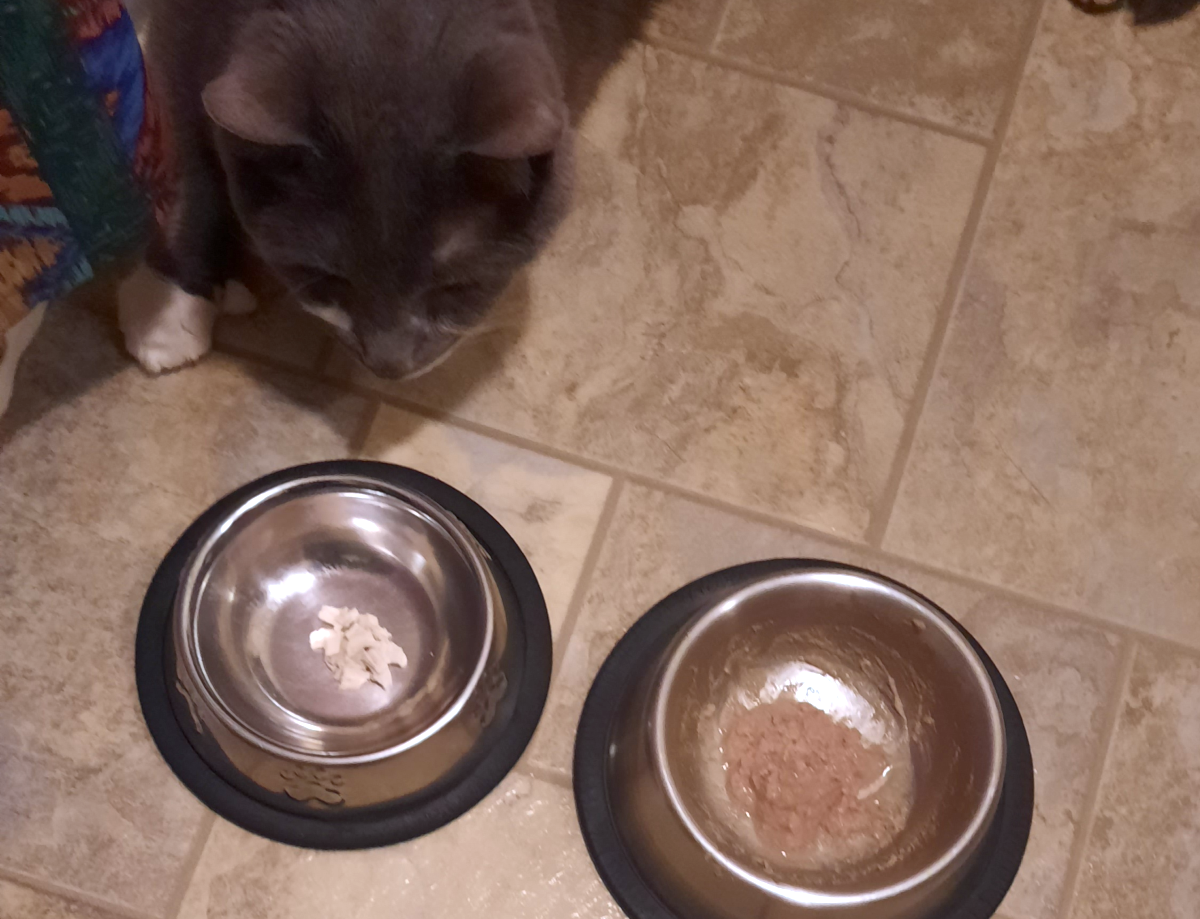
Some commercially available products are intended as treats or meal enhancers rather than complete diets. Shredded chicken, tuna, seafood mixtures, broths, and other supplemental products may appeal to a selective cat without providing the full range of nutrients required for long-term feeding. Labels identifying a product as intended for intermittent or supplemental feeding indicate that it should not ordinarily serve as the animal’s sole diet.
These products can be useful for adding variety or encouraging a reluctant eater, but the amount consumed matters. If a cat regularly eats the topper while leaving most of its balanced meal behind, its overall nutritional intake may become inadequate. Cornell’s feeding guidance recommends keeping treats to a relatively small portion of daily calories, generally no more than about 10 to 15 percent.
An older cat with dental discomfort, nausea, or another medical problem may develop a preference for softer or more appealing supplemental foods. In those circumstances, simply removing the preferred food may not resolve the underlying difficulty. Identifying why the cat is avoiding its regular diet allows a more appropriate feeding plan to be developed without relying indefinitely on nutritionally incomplete alternatives.
Recognizing Possible Signs of Taurine Deficiency
 Taurine deficiency can be difficult to recognize because its effects usually develop gradually and may resemble unrelated medical conditions. A cat experiencing retinal degeneration might become hesitant in unfamiliar surroundings, misjudge jumps, or have trouble locating objects. Those changes can also occur with other visual disorders, so behavior alone cannot establish a nutritional deficiency.
Heart-related complications may produce reduced activity, fatigue, changes in breathing, or difficulty tolerating exertion. Unfortunately, cats with significant heart disease sometimes show few obvious symptoms until the condition has progressed. A normal appetite or familiar daily behavior does not necessarily rule out underlying heart problems.
Labored breathing, open-mouth breathing, collapse, or sudden weakness or paralysis of one or more legs requires immediate emergency veterinary care. These signs can indicate serious cardiovascular or circulatory conditions, including heart failure or an arterial blood clot. They are not specific to taurine deficiency and should never be managed by attempting nutritional supplementation at home.
A veterinarian investigating possible taurine deficiency may review the cat’s complete feeding history and measure taurine concentrations in blood. Depending on the clinical findings, additional testing may include an echocardiogram to evaluate the heart or a detailed retinal examination. Taurine measurements must be interpreted alongside the diet, medical history, and examination results because similar symptoms can arise from numerous other conditions.
Why Taurine Deserves Attention in Senior Cats
Aging does not eliminate a cat’s requirement for dietary taurine. Healthy older cats continue to need nutritionally adequate food, although their overall dietary needs may change with body condition, activity, digestion, and existing medical conditions. Cats managing chronic illness may face additional challenges when maintaining consistent food intake.
Kidney disease, diabetes, hyperthyroidism, and dental problems can complicate feeding decisions. Some conditions require therapeutic diets, while others affect appetite, body weight, or the ability to eat comfortably. A properly formulated veterinary therapeutic diet should provide the nutrients needed for its intended use, including taurine when designed as a complete diet.
There is also a practical difference between offering a balanced diet and having a cat consume enough of it. An older cat that regularly leaves most of its food uneaten may receive inadequate calories and essential nutrients despite being offered an appropriate product. Persistent poor appetite can create more immediate medical concerns than a gradual taurine deficiency, particularly because cats that consume too little food are at risk of serious complications, including hepatic lipidosis, commonly called fatty liver disease.
Changes in appetite deserve attention before substantial weight loss develops. Recording what food was offered, approximately how much was consumed, and whether the cat showed difficulty chewing or swallowing can provide useful information. A cat that stops eating entirely should receive prompt veterinary assessment, especially when older, overweight, or already managing a medical condition.
Should You Give Your Cat a Taurine Supplement?
 Most healthy cats eating sufficient amounts of complete and balanced commercial cat food do not require separate taurine supplementation. Their diets are already formulated to provide appropriate quantities, and routine supplementation has not been established as necessary for otherwise healthy cats receiving adequate taurine.
Supplementation may be appropriate when a veterinarian identifies a deficiency or determines that a medical condition warrants it. Cats diagnosed with taurine-related DCM, for example, may receive supplemental taurine alongside other treatments needed to manage their heart disease. Correcting the underlying dietary problem is also necessary to prevent the deficiency from continuing.
The outlook depends on the severity and duration of the condition. Cats with taurine-responsive heart disease may show meaningful improvements after treatment, but advanced heart failure or other complications can limit recovery. Retinal degeneration may stop progressing after taurine intake is corrected, although existing structural damage can remain permanent.
Taurine supplements are generally considered well tolerated, and serious adverse effects from excess dietary taurine have not been well documented in cats. However, supplement quality and formulation can vary, and the appropriate treatment depends on the animal’s health and nutritional history. Adding taurine without investigating an inadequate diet may also leave other deficiencies uncorrected.
Keeping Taurine Intake Consistent Through Everyday Feeding
Maintaining adequate taurine intake generally begins with selecting a complete and balanced cat food appropriate for the animal’s life stage and medical needs. Wet and dry foods can both satisfy this requirement when properly formulated, allowing feeding decisions to account for appetite, texture preferences, hydration needs, and household routines.
When changing brands or formulations, check the nutritional adequacy statement on the replacement food. Similar ingredient lists do not necessarily mean that two products supply equivalent nutrition, and terms such as natural, premium, or minimally processed do not establish nutritional completeness. A gradual transition over several days is generally easier for many cats to tolerate, provided there is no medical reason for a different approach.
For a senior cat with chronic illness, dietary adjustments may involve several nutritional considerations at once. A cat with kidney disease, for example, may need controlled phosphorus intake while still receiving sufficient calories, protein, and essential amino acids to support body condition. The appropriate balance depends on the stage of disease, appetite, laboratory findings, and the specific therapeutic diet being considered.
One of the most useful habits is keeping a simple record of the food a cat actually consumes. The brand, formulation, approximate daily amount, treats, toppers, and noticeable appetite changes provide a clearer dietary history than the name of the primary food alone. Such records are especially helpful when several family members share feeding responsibilities or when medications and medical conditions affect appetite.
Food records can also reveal problems that are easy to overlook during ordinary caregiving. A cat that has gradually shifted from eating complete meals to consuming mostly treats or plain meat may still appear interested in food while receiving an increasingly unbalanced diet. Recognizing that pattern gives the owner and veterinarian an opportunity to address food preferences, underlying health problems, and nutritional adequacy before a prolonged deficiency develops.